Tuesday, January 15, 2013

Former Utah CIO Steve Fletcher Joins NTIA


Former Utah CIO Stephen Fletcher has taken a position with the National Telecommunications & Information Administration (NTIA), heading-up the newly created Office of Public Safety Communications (OPSC).

The OPSC will oversee the state and local public safety grant program established by the Middle Class Tax Relief and Job Creation Act of 2012. The office will also assist FirstNet (First Responder Network Authority) — which is charged with rolling out the National Public Safety Broadband Network — with procurement and other activities.

Fletcher has been on the job as associate administrator of the OPSC since Nov. 5, 2012. In an email with Government Technology, he said that he’s followed the activities of the public safety community for years and was excited to see legislation passed to establish FirstNet.

“I am intrigued by the idea that this will be a start-up venture under the umbrella of government,” Fletcher wrote. “It is a big, complex project — a nationwide project — and this is very appealing to me. This project will also allow me to continue to interact with all of the state and local relationships I have built up over the years.”

FirstNet will build and deploy the new nationwide emergency broadband network based on a single, national, network architecture. It will enable true interoperability among first responders and public safety officials across the country.

Fletcher’s diverse background should lend itself nicely to his new role. He served as CIO both for Utah and the U.S. Department of Education, developing knowledge about the procurement and grant-making process. He was responsible for the communications-related functions of Utah’s statewide public safety network.

Appointed Utah’s CIO in 2005, Fletcher was noted for his leadership with regard to the state’s enterprisewide IT consolidation and centralization. He also is a past president of the National Association of State Chief Information Officers, and in 2008 was named one of Government Technology’s Top 25 Doers, Dreamers and Drivers.

Fletcher resigned as CIO of Utah last May, after a huge security breach in the Utah Department of Health. Discovered on April 2, the March 30 breach was believed to compromise 280,000 Social Security numbers and the personal information of approximately 500,000 people, including names, addresses, birth dates and some details contained in patient health records.

Despite his less-than-celebrated exit from Utah, Fletcher said he believes the experience is something he can apply to FirstNet as it comes to fruition. He felt the biggest lesson learned from the Utah data breach is that in projects of that size — or in an emergency — it’s critical to increase the level of communication among stakeholders.
“The best way to do that is to plan for it and build it from inception,” Fletcher said. “So when an emergency happens you will … be able to react to the problem rather than first having to define the process. This will be useful as the network unfolds.”
Photo courtesy of the National Telecommunications & Information Administration

Wednesday, January 9, 2013

5 in 5

We think of the five senses as exclusive to living things

Processing sights and sounds requires eyes, ears and, most important, a brain—right? But what if your hardware shared your senses?

In the era of cognitive computing, systems learn instead of passively relying on programming. As a result, emerging technologies will continue to push the boundaries of human limitations to enhance and augment our senses with machine learning, artificial intelligence (AI), advanced speech recognition and more. No need to call for Superman when we have real super senses at hand.

This year IBM presents The 5 in 5 in five sensory categories, through innovations that will touch our lives and see us into the future.


From IBM's Chief Innovation Officer
Read what he says about The 5 in 5 


Poll results


Touch: You will be able to touch through your phone

In the 1970s, when a telephone company encouraged us to "reach out and touch someone," it had no idea that a few decades later that could be more than a metaphor. Infrared and haptic technologies will enable a smart phone's touchscreen technology and vibration capabilities to simulate the physical sensation of touching something. So you could experience the silkiness of that catalog's Egyptian cotton sheets instead of just relying on some copywriter to convince you.


Hearing: Computers will hear what matters

Before the tree fell in the forest, did anyone hear it? Sensors that pick up sound patterns and frequency changes will be able to predict weakness in a bridge before it buckles, the deeper meaning of your baby's cry or, yes, a tree breaking down internally before it falls. By analyzing verbal traits and including multi-sensory information, machine hearing and speech recognition could even be sensitive enough to advance dialogue across languages and cultures.

Taste: Digital taste buds will help you eat smarter

The challenge of providing food—whether it's for impoverished populations, people on restricted diets or picky kids—is in finding a way to meet both nutritional needs and personal preferences. In the works: a way to compute "perfect" meals using an algorithmic recipe of favorite flavors and optimal nutrition. No more need for substitute foods when you can have a personalized menu that satisfies both the calorie count and the palate.

Smell: Computers will have a sense of smell

When you call a friend to say how you're doing, your phone will know on the full story. Soon, sensors will detect and distinguish odors: a chemical, a biomarker, even molecules in the breath that affect personal health. The same smell technology, combined with deep learning systems, could troubleshoot operating-room hygiene, crops' soil conditions or a city's sanitation system before the human nose knows there's a problem.

Monday, January 7, 2013

The Pope is on Twitter: Is Your Business Centre Following Suit?

Published Thursday, December 6th, 2012, by Jo Disney - News and Features Editor, U.K.


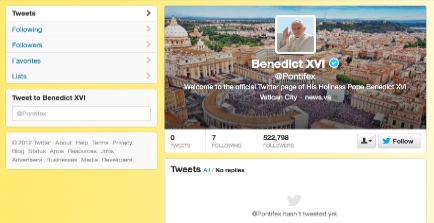
Pope Benedict is set to make his Twitter debut on 12th December. It just goes to show that social channels like Twitter can help organisations of any type, size, purpose and stature connect with people from all walks of life. If the 85-year old Pope can embrace such a medium, there’s no reason why business centres shouldn’t be doing it. And doing it well.

Pope Benedict is on Twitter
What’s so important about Twitter?

Twitter was only launched in 2006. Yet today, hundreds of millions of tweets are posted daily, and Twitter.com is ranked as one of the ten most-visited websites worldwide. It has over 500 million active users as of 2012 and handles over 1.6 billion search queries per day. It’s no surprise that the micro-messaging platform has become known as “the SMS of the Internet.”

However, many people and businesses are still failing to use social media to its full potential. A recent study from BusinessNext found that only 20% of CMOs (Chief Marketing Officers) in Fortune 100 companies are active in social networks – that’s just one in five.

Just like those ‘missing’ CMOs, any flexible office space operator not actively using Twitter is missing out on a valuable marketing and communications channel. It’s not a difficult tool to use. But it does require a little time and regular, engaging updates to make it worthwhile. Do this, and it will certainly be time well spent.
To help you get onto the Twittersphere, ABCN has gathered five top tips on how to use Twitter effectively, with help from online social media experts:

Five Top Tips on How to Use Twitter

1) Learn the lingo
As Marketing Donut says, the lingo can be a little boggling at first. RT, @, #, or DM? But don’t let it put you off. You can quickly get up to speed with the lingo through the Twitter glossary – and a little practice.

2) Share valuable content in your own voice
When tweeting, replying or promoting, do so in a style that matches your personality or brand, says Mari Smith of Social Media Examiner. Add value but try not to do the hard sell. You want people to read your tweets and be compelled to respond, so “be human”.

3) Engage and give
James Blute says “Give freely and they will follow (and tell their friends).” He recommends engaging with followers and answering questions both publicly and privately. He also gives professional advice freely to show users that he can be trusted – meaning they are more likely to becoming paying customers later on.

4) Get organised
ThingsIdigg.com recommends using a programme such as TweetDeck or Hootsuite to organise your tweets. These programmes also let you schedule tweets to go live at specific times – perfect if you’re going to be out of the office.

5) Add keywords
If you’re already familiar with the concept of using keywords in your blogs and web content, Twitter is a natural extension of this. Shannon Willoby of Scott’s Marketplace recommends one keyword per tweet to get more SEO ‘juice’. However she advises not to go overboard – after all, Twitter is a conversation and should be focused on engaging content, rather than keyword-stuffed messages.

Armed with these simple tips, when will your business centre join Pope Benedict on Twitter?

Wednesday, December 19, 2012

What Does the Office of the Future Look Like?

Blackspaces coworking space


For the commercial property industry, that’s a million dollar question.

Peer inside a dozen different office buildings and the chances are you will see a dozen different office cultures. The office as we know it has come a long way – cubicle farms and private office space are giving way to open-plan offices, and from traditional long-term leases came flexible serviced offices. Furthermore, free Wi-Fi in cafes helped to promote the co-working movement.

There are numerous theories and suggestions about the future workplace. The common ground seems to be that the future office will most likely reflect the requirements of a much more flexible and mobile workforce. For example, a recent Regus study – ‘Flexibility Drives Productivity‘ – found “hard evidence” that flexible working helps to overcome barriers for growth. Their research claims that 72% of global businesses reported increased productivity as a direct result of flexible working practices.
The Regus study also found that 68% of firms declared that flexible working led to staff generating increased revenue.


If flexible working equals increased revenue, that’s surely the route most – if not all – profit-seeking businesses will want to take. So the future office certainly seems to be one that will pander to the needs of a more flexible workforce, whether that be mobile workers, part-timers, freelancers or homeworkers.
The aptly named Office of the Future: 2020 goes further into the concept.

Featuring a comprehensive range of research studies conducted by staffing organisation Office Team, the general consensus is that there will be fewer set locations, and employees will increasingly work from diverse locations, with teams equipped to work – and be managed – on a remote basis. From a staffing perspective, those people that can adequately adapt to new situations and fit into a work-on-the-go environment will be in demand.

Office of the Future: 2020 predicts that technology will play a significant role in allowing staff to work off-site, while companies will come to rely on a range of plug ‘n play environments within which to land. Essentially, “going to work” will be redefined as employees become more mobile.
Technology is at the crux of progress for both work-on-the-go professionals and the workspace industry. Jerome Chang, founder of co-working facility BLANKSPACES, believes that workspace and technology are intrinsically linked.

“I see coworking and real estate the same as software and hardware. Once every Joe is comfortable with computers, then we can move toward Web 1.0, then 2.0, and hopefully, mobile. By then, we’ll see many more nimble workspaces in airports, malls, and hotels. Everything from how power and data is distributed will be more standardized.”

He believes that concierge or front desks will be commonplace, helping workers to get acquainted with the day’s touchdown space. He thinks that landlords will become more like today’s cloud servers, in the sense that their office space will be “modular, reconfigurable spaces”.

Bridget Hardy of Integrans Consulting believes that the future workplace will be more of a ‘pay as you go’ environment. Rather than rows of static desks, the space will work harder and offer more options – such as collaborative spaces, “huddle areas” and quiet areas for workers to “get their heads down”.
Offices that ‘work harder’ to make better use of available space, helping to minimise floor plates and reduce overheads certainly seems a viable solution. Combine this with the evidence that greater flexibility at work results in happier staff and bigger revenue margins, and you’ve got the makings of a recipe for success.

What’s your view on the future office?

Tuesday, November 27, 2012

Convergence of Emergency Voice and Data

By Lori MacVittie, Senior Technical Marketing Manager

This article originally appeared in the October 2012 issue of INTERNET TELEPHONY

None of my adult children have a land line. It is unlikely they ever will – or will even consider it. They’re millennials, and grew up in a digital world where phones are mobile, kept in your pocket, and used for texting and social networking and web access, not calling mom to see how she’s doing.

It’s unlikely that they – or others sharing their view on communications – have considered what that means to their ability to obtain emergency services should they need them.

When organizations first started moving toward a converged network comprising both voice and data, the uproar over emergency services was heard loud and clear. Emergency service systems were designed to tag  phone numbers to specific addresses for rapid response, based on the premise that a physical wire actually connected the phone to a location.

But that’s no longer the case. The increasingly unwired nature of technology ignores that premise and ultimately breaks the system. E911 was developed to address this disconnect and systems were added that were able to use geo-location through techniques such as triangulation as a means to pinpoint an address. VoIP complicated things yet again, and the sometimes inaccurate databases tying IP addresses to locations frustrated implementers. The addition of tablets and Wi-Fi-enabled phones only serves to exacerbate the difficulties emergency services has with trying to identify the location of a caller in need of assistance. Though most phones and tablets are enabled with GPS, the data from which could be used to solve this problem, many users are reluctant to allow any application to share that data or have turned off the functionality because of its tendency to draw too much power and drain battery reserves faster than they can update Facebook.

In North America, location is determined by querying the automation location information database, maintained by third parties (typically the ILEC). Data from the ALI can be used to route the call to the appropriate local authorities as well as determine the location of the caller. Except the way in which the ALI is updated is not necessarily compatible with mobility. It’s not necessarily updated in real time, which means despite the availability of up-to-date GPS coordinates from most mobile devices, a call to emergency services might tag you as being at home, when you’re really at the local Dunkin Donuts.

That’s a problem, and one that’s increasing as VoIP becomes more popular as a means to communicate, especially for millennials. VoIP even on mobile phones is common with the next generation, and the rising popularity of tablets (which do not come with phone numbers) encourages the use of such peer-to-peer (especially as they’re generally free) communications.

There is a growing need to find a longer-term solution to the problem of locating a caller that is accurate in real-time across both the IP and traditional carrier space. A more modern solution may require a radical change in the networking layer to support the inevitable transition of more and more communications to a digital format.

Perhaps we can take a cue from the lowest levels of the networking stack and geo-stamp packets much as we timestamp them. Perhaps there’s a need for a new Ethernet type, the E911 type, which clearly indicates packets carry time-sensitive, critical calls for help.

A more network-oriented solution – given that almost all emergency traffic flows over networks today – may be the answer to resolving the disconnect between the two worlds. Giving infrastructure the ability to geo-stamp a specific traffic type may provide the best answer, given the preponderance of availability of such data from devices whether accessing services over the Internet or a carrier’s cellular network. The emergence of LTE makes this possibility even more likely – and achievable – given the convergence under the covers of voice and data running on the same network.

It seems feasible, then, that network infrastructure play some role in ensuring that calls for help – whether via VoIP, SMS, or cellular – be identifiable when mixed in among traffic carrying status updates and streaming video of cats dancing to the latest Lady Gaga tune.

Lori MacVittie is senior technical marketing manager at F5 Networks (www.f5.com). 

Thursday, November 1, 2012

Marketing Services


View our profile on LinkedIn    Follow us on Twitter    Visit our blog                      PR/Social Media Monthly Package                www.susansaldibar.com

 
Three Ideas to Get Your Business Back "Out There"! 


I've spoken with so many business owners and managers who are tired of being in "hunker down" mode until the economy improves. They talk about spending most of their time just trying to get enough sales in the door to stay reasonably healthy. Some have taken a sort of checkerboard marketing approach, trying a little bit of this and that to grab another customer. They've been hammered by the economy and they are still weathering the storm.

Most of us agree that the economy will come back regardless of who becomes president this next month. We all have our opinions as to who will bring it back more quickly, but we keep our eyes open for the light at the end of the tunnel.

What can you do as a business, to reaffirm your value and "get out there" to compete effectively, as the economy thaws and buyers start looking for things to buy again? Here are a few ideas that most small businesses agree won't break the bank and will have a net positive effect:
  1. The Plan: You've probably drifted a bit with your focus and messaging to get business in the door. Get the team together and spend a few hours going back over your plan. Lots of things can change in a couple of years.  Make adjustments, reaffirm your unique value, and adjust your corporate descriptions and whatever else needs to be adjusted. 

  1. Distribute Content: Now to the get back "out there" part. Let people know you're still very much around. Start by checking out your website. Is it fresh or stale? Get some fresh content on the pages and make sure they are search-engine-friendly. Start a short newsletter. Keep it simple, interesting and brand reflective.    

  1. Customer Voice: When was the last time you did a customer case story? Reach out to customers who are happy with your product. These "stories" can be used in all areas of your marketing.
Don't put this on the back burner until after the holiday season. Start it now! And, you know I can help you with it. Do these things and, come January, you'll be in a better position to meet the New Year head on, and the new competitors that may come with it!

__________________________________________________________________ 
 
Susan Saldibar Marketing, provides expert marketing consulting and services to small-mid sized businesses who are serious about growing to the next level, but want to avoid hiring a full time marketing executive. We help them get the results they thought were out of reach, by re-aligning their marketing actions to put their product in front of their ideal customer.  Check out my PR/Social Media Package to jumpstart or re-start your PR and social media! 

Did you know that I offer a 1-hour free consultation? I follow it up with an outline that provides immediate value to your business, identifying some things you can do immediately to improve the effectiveness of your marketing activities. I also have two new packages for website revamping and social media. I'm happy to share them with you. Drop me an email at info@susansaldibar.com or call me at 714 757-3082. 

The "trick" is to do it right the first time; the "treat" is a growing customer list! 

 "The greatest thing in life is to keep your mind young."
  ~ Henry Ford  

The Dudash Group


You’ve most likely met me through my employment with Executive Office Centers, Alliance, Vantas, HQ Global Workplaces, Alliance Business Centers Network, Corporate Office Centers, Synergy Workplaces, and most recently, Carr Workplaces and the Preferred Office Network.  After 21+ years of combined service to these outstanding groups, I have started my own e-suite consulting business and believe my services could be of significant value to you.   Who better to help your company than someone who has walked the walk and talked the talk?

My specialty is developing operational systems to ensure efficiencies and increased profits. I analyze the problem, make recommendations, and execute changes needed for a smoother-running company. Whether it's developing company procedures, acting as project manager during business center openings, facilitating an acquisition/integration, performing on-site center audits, assisting with special projects, or providing ongoing operational support, I can handle it for you.

My reputation speaks for itself, not to mention the numerous endorsements I have of my work.  You can't ask for a better partner! Take a look at some of the many services available to you:

·         On-site project manager to oversee opening of new locations or integration/acquisition of centers
·         Internal Intranet design & maintenance
·         Creation of company Standard Operating Procedures
·         Development of "Center Readiness Evaluation & Standards Review" form & process
·         Performing those onsite center reviews at your centers
·         HR – including interviewing & onboarding
·         Training program design & implementation
·         Team member handbooks
·         Job descriptions
·         Bonus plans
·         Dress code creation & rollout
·         Business etiquette training
·         Employee evaluation programs
·         Rewards & recognition programs
·         Secret shop – telephone or in person
·         Collection processes
·         Internal & external newsletters
·         Client welcome process and tools
·         Client surveys – annual, move-in and move-out
·         Use of Morningstar and Salesforce
·         ...and so much more!

If any of my services are of interest to you, let's discuss how I can help your business run smoother, more efficiently, and grow into the business you know it can be.


Nancie Dudash
760-328-8888
thedudashgroup@gmail.com