Thursday, May 2, 2013

6 Reasons to Move Your Home Office to a Shared Office Space

  01 May 2013    Posted by Brad Roark   

Between kids being home for the summer and the day-to-day distractions of working from home, now might be the time to consider moving your home business to a shared office space. Read on for six reasons why this is a smart idea.

Fewer Distractions
Unless you live in a totally immaculate, kid-, pet-, and partner-free space, chances are there are plenty of things going on in your home that are taking your attention away from your work. Moving your office out of your house means fewer disruptions, from kids needing lunch to pets wanting walks to the siren call of dirty dishes.

Better Work/Life Split
Working at home comes with the unfortunate reality of the never-ending workday. Unlike those who can leave an office at 5pm and forget about work until the next morning, your home office is always beckoning. By renting shared office space, you have more of a chance to leave work at work and spend time focusing on your family (or yourself!) when you’re done for the day.

Opportunity for Collaboration
 At home, it’s just you in your office. While you can certainly call colleagues and friends to brainstorm and collaborate, there’s less of a chance that you’ll stumble onto a great idea in the course of a conversation. If you take your work to a shared office or co-working space, however, you’ll likely spend more time chatting with fellow professionals, leading to more sparks of inspiration.

Fewer Temptations
Because you’re not “at work” when you’re at home, it can be easy to take extended breaks to go out for lunch with friends, watch TV while you work, or put off work for later in the day to catch up on sleep. One of the benefits of a shared office space is that you actively “go to work,” which might help you focus and take your work more seriously.

Better Setup
Home offices are often lacking in the set-up department. Maybe you’re using a printer from 1997; maybe you’re using a kitchen chair at your desk instead of something ergonomic with wheels; maybe the closet in your home office is overflowing with clothes you keep meaning to donate. Regardless of your specific situation, moving to a shared office means you get to take advantage of space planned specifically for work, featuring better technology than you might invest in for your home office, and likely better lighting and less clutter.

Opportunity for Growth
Finally, getting your business out of your house means that you’re no longer confined by the space of your home office. Shared office space and co-working spaces are, by nature, flexible, meaning you can have all the space you need to hire another employee and see clients in a more professional environment.


Author
Brad Roark is part of the marketing team at Office Suites PLUS. Catch him on twitter @bradaroark & Google+.


Monday, March 4, 2013

Why Your Office Will Disappear

If you’re like most people, you work in a high-rise building alongside colleagues who, much of the time, are away from their seats in meetings, at lunch or traveling for business.

Get ready for drastic change. A global recession, emerging sharing economy and more buy in to climate change are each pointing boardrooms toward efficiency. Your office as you know it will be gone.

Where will you work?
You’ll have to come to Austin next week to find out. For the second year running, innovators in work design will host the biggest coworking conference in the world. For those of you new to the concept, collaborative work spaces everywhere are defining themselves as “coworking spaces,” or workplaces that foster productivity, collaboration and community. According to Deskmag, the number of coworking spaces has grown 200% annually for seven years. Want to see a map? LiquidSpace will show you options in 350 cities around the world. The Workspace Association of New York represents over 2 million square feet in the Tri-State area alone, managing a powerful center of influence. The Global Coworking Unconference Conference (GCUC), or “Juicy” as its commonly known, aims to bring together the best and brightest minds in the movement, to share ideas and inspiration and develop new strategies for the future.

Disclosure: The author Marissa Feinberg is the shared office space owner of Green Spaces NY, upcoming member of LEXC, cofounder of Flockd and attends GCUC. Read on.
Turnstone's "Bivi" Furniture

The Future
COOs will not continue to pay high electric bills and real estate costs for people who use their space 30% of the time. Your HR departments have already started calling me and my peers for pricing, and booking tours and visits given by our “Community Managers”. We are the proud proprietors of the new world of coworking.
Map of Link Coworking

We design for efficiency; our business models depend on it. We are daring entrepreneurs who have challenged the status quo to create unique environments, building blueprints as we progress. The design of the traditional corporation and office suite will be dated, your company’s seats will be re-situated, or you will be relocated to wonderful coworking spaces.
WeWork in New York via Business Insider

The League of Extraordinary Coworking Spaces (LEXC),  a unique network of coworking spaces with a common standard of excellence, has become the go-to resource for corporations expanding their workplace strategy to include coworking. Gathering industry pioneers, the organization’s first corporate customer is Accenture. Especially smart for its mobile workers, LEXC makes a compelling case to try a new work solution.

“Commercial real estate is no longer about a square foot; it’s a state of mind,” says Brian Macmahon of Your Office Agent, a commercial agency specializing in lean work space. “Facilities plans have been kept too separate from business plans for far too long. Forward-thinking companies of all sizes are exploring these new models.”
WorkBar in Boston via Inc.com

As big business comes aboard the revolution, the triple bottom line gets better. American Express recently lowered its carbon footprint by 27.5 percent, citing a decrease in business travel and the creation of centers for virtual meetings. Widely recognized for championing economic development and entrepreneurship is Zappos CEO Tony Hsieh, now championing Las Vegas to become the coworking capital of the world.
Grind in New York, credit Jaeger/Sloane Inc.

What Your Office Will Look Like
Office layouts will be more structured for liquid, easy work. Office design innovation leaders like Turnstone make coworking furniture lighter and more comfortable. The architectural silos that separate departments will erode. You will know more about what’s happening in other areas of your organization. Open plans will create cafe-like atmospheres and promote creativity and transparency.
Flockd, a workplace tool signaling productivity and connectivity

New workplace tools like Flockd will help people across departments start conversations while increasing productivity. You’ll interact with coworkers in a more friendly, approachable and transparent way. Resources like kitchens, coffee, bathrooms, conference rooms and office supplies will be shared more often. Take a deep breath and get ready to share that pen in your hand, and maybe your monitor too!
Blankspaces in LA and Santa Monica via Inc.com

Don’t Fret, You’ll Benefit
FastCompany recognizes the serendipitous, positive function of proximity stimulating innovation. A recent study found “the best, most-widely cited research came from coauthors sitting less than 10 meters apart. ‘How closely they worked mattered as much, if not more, than their affiliation,’ says the study’s author, Isaac Kohane of Harvard Medical School. Coworking’s combination of casual relationships and shared spaces, he suggests, can lead to some of an employee’s most fruitful collaborations.”
New Work City in New York, stomping grounds of coworking granddaddies 
Tony Bacigalupo and Peter Chislett

Juicy Questions? We have them too. We’re gathering March 5th and 6th for panels on, “Corporations and Coworking,” “Alternative Funding,” “Can Coworking Have a Deeper Impact on Society?” among others. See the full list of events here. The hybrid conference-unconference mixes professional speaking with collaborative DIY sessions.
Liz Elam, Curator of Link Coworking, Producer of Global Coworking Unconference Conference, President of League of Extraordinary Coworking Spaces

Led most recently by dynamo Liz Elam, founder of Link Coworking and president of LEXC, GCUC is largely a grassroots effort with support from a wide range of volunteers and sponsors. In a former life, Liz was a top sales executive at Dell; you can see where this trend started. It takes a tireless, inspired team to drive any behavior-change effort. Read more about them here.

How GCUC works
Keynote speakers include coworking space owners, property managers, investors, academics, and serial entrepreneurs. It’s a diverse crowd of professionals, all connected to the coworking movement in different ways. The official Twitter speak is @AustinGCUC, #GCUC and #unGCUC.

Global Coworking Unconference Conference (GCUC), Known as "Juicy" via GCUC website

People are traveling from every continent to join the dialog that will define the future of how we work, so buckle up!

Tuesday, January 15, 2013

Former Utah CIO Steve Fletcher Joins NTIA


Former Utah CIO Stephen Fletcher has taken a position with the National Telecommunications & Information Administration (NTIA), heading-up the newly created Office of Public Safety Communications (OPSC).

The OPSC will oversee the state and local public safety grant program established by the Middle Class Tax Relief and Job Creation Act of 2012. The office will also assist FirstNet (First Responder Network Authority) — which is charged with rolling out the National Public Safety Broadband Network — with procurement and other activities.

Fletcher has been on the job as associate administrator of the OPSC since Nov. 5, 2012. In an email with Government Technology, he said that he’s followed the activities of the public safety community for years and was excited to see legislation passed to establish FirstNet.

“I am intrigued by the idea that this will be a start-up venture under the umbrella of government,” Fletcher wrote. “It is a big, complex project — a nationwide project — and this is very appealing to me. This project will also allow me to continue to interact with all of the state and local relationships I have built up over the years.”

FirstNet will build and deploy the new nationwide emergency broadband network based on a single, national, network architecture. It will enable true interoperability among first responders and public safety officials across the country.

Fletcher’s diverse background should lend itself nicely to his new role. He served as CIO both for Utah and the U.S. Department of Education, developing knowledge about the procurement and grant-making process. He was responsible for the communications-related functions of Utah’s statewide public safety network.

Appointed Utah’s CIO in 2005, Fletcher was noted for his leadership with regard to the state’s enterprisewide IT consolidation and centralization. He also is a past president of the National Association of State Chief Information Officers, and in 2008 was named one of Government Technology’s Top 25 Doers, Dreamers and Drivers.

Fletcher resigned as CIO of Utah last May, after a huge security breach in the Utah Department of Health. Discovered on April 2, the March 30 breach was believed to compromise 280,000 Social Security numbers and the personal information of approximately 500,000 people, including names, addresses, birth dates and some details contained in patient health records.

Despite his less-than-celebrated exit from Utah, Fletcher said he believes the experience is something he can apply to FirstNet as it comes to fruition. He felt the biggest lesson learned from the Utah data breach is that in projects of that size — or in an emergency — it’s critical to increase the level of communication among stakeholders.
“The best way to do that is to plan for it and build it from inception,” Fletcher said. “So when an emergency happens you will … be able to react to the problem rather than first having to define the process. This will be useful as the network unfolds.”
Photo courtesy of the National Telecommunications & Information Administration

Wednesday, January 9, 2013

5 in 5

We think of the five senses as exclusive to living things

Processing sights and sounds requires eyes, ears and, most important, a brain—right? But what if your hardware shared your senses?

In the era of cognitive computing, systems learn instead of passively relying on programming. As a result, emerging technologies will continue to push the boundaries of human limitations to enhance and augment our senses with machine learning, artificial intelligence (AI), advanced speech recognition and more. No need to call for Superman when we have real super senses at hand.

This year IBM presents The 5 in 5 in five sensory categories, through innovations that will touch our lives and see us into the future.


From IBM's Chief Innovation Officer
Read what he says about The 5 in 5 


Poll results


Touch: You will be able to touch through your phone

In the 1970s, when a telephone company encouraged us to "reach out and touch someone," it had no idea that a few decades later that could be more than a metaphor. Infrared and haptic technologies will enable a smart phone's touchscreen technology and vibration capabilities to simulate the physical sensation of touching something. So you could experience the silkiness of that catalog's Egyptian cotton sheets instead of just relying on some copywriter to convince you.


Hearing: Computers will hear what matters

Before the tree fell in the forest, did anyone hear it? Sensors that pick up sound patterns and frequency changes will be able to predict weakness in a bridge before it buckles, the deeper meaning of your baby's cry or, yes, a tree breaking down internally before it falls. By analyzing verbal traits and including multi-sensory information, machine hearing and speech recognition could even be sensitive enough to advance dialogue across languages and cultures.

Taste: Digital taste buds will help you eat smarter

The challenge of providing food—whether it's for impoverished populations, people on restricted diets or picky kids—is in finding a way to meet both nutritional needs and personal preferences. In the works: a way to compute "perfect" meals using an algorithmic recipe of favorite flavors and optimal nutrition. No more need for substitute foods when you can have a personalized menu that satisfies both the calorie count and the palate.

Smell: Computers will have a sense of smell

When you call a friend to say how you're doing, your phone will know on the full story. Soon, sensors will detect and distinguish odors: a chemical, a biomarker, even molecules in the breath that affect personal health. The same smell technology, combined with deep learning systems, could troubleshoot operating-room hygiene, crops' soil conditions or a city's sanitation system before the human nose knows there's a problem.

Monday, January 7, 2013

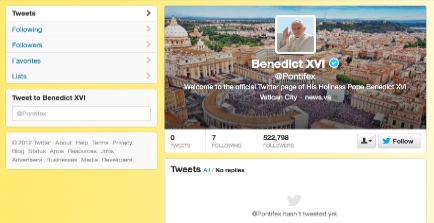
The Pope is on Twitter: Is Your Business Centre Following Suit?

Published Thursday, December 6th, 2012, by Jo Disney - News and Features Editor, U.K.


Pope Benedict is set to make his Twitter debut on 12th December. It just goes to show that social channels like Twitter can help organisations of any type, size, purpose and stature connect with people from all walks of life. If the 85-year old Pope can embrace such a medium, there’s no reason why business centres shouldn’t be doing it. And doing it well.

Pope Benedict is on Twitter
What’s so important about Twitter?

Twitter was only launched in 2006. Yet today, hundreds of millions of tweets are posted daily, and Twitter.com is ranked as one of the ten most-visited websites worldwide. It has over 500 million active users as of 2012 and handles over 1.6 billion search queries per day. It’s no surprise that the micro-messaging platform has become known as “the SMS of the Internet.”

However, many people and businesses are still failing to use social media to its full potential. A recent study from BusinessNext found that only 20% of CMOs (Chief Marketing Officers) in Fortune 100 companies are active in social networks – that’s just one in five.

Just like those ‘missing’ CMOs, any flexible office space operator not actively using Twitter is missing out on a valuable marketing and communications channel. It’s not a difficult tool to use. But it does require a little time and regular, engaging updates to make it worthwhile. Do this, and it will certainly be time well spent.
To help you get onto the Twittersphere, ABCN has gathered five top tips on how to use Twitter effectively, with help from online social media experts:

Five Top Tips on How to Use Twitter

1) Learn the lingo
As Marketing Donut says, the lingo can be a little boggling at first. RT, @, #, or DM? But don’t let it put you off. You can quickly get up to speed with the lingo through the Twitter glossary – and a little practice.

2) Share valuable content in your own voice
When tweeting, replying or promoting, do so in a style that matches your personality or brand, says Mari Smith of Social Media Examiner. Add value but try not to do the hard sell. You want people to read your tweets and be compelled to respond, so “be human”.

3) Engage and give
James Blute says “Give freely and they will follow (and tell their friends).” He recommends engaging with followers and answering questions both publicly and privately. He also gives professional advice freely to show users that he can be trusted – meaning they are more likely to becoming paying customers later on.

4) Get organised
ThingsIdigg.com recommends using a programme such as TweetDeck or Hootsuite to organise your tweets. These programmes also let you schedule tweets to go live at specific times – perfect if you’re going to be out of the office.

5) Add keywords
If you’re already familiar with the concept of using keywords in your blogs and web content, Twitter is a natural extension of this. Shannon Willoby of Scott’s Marketplace recommends one keyword per tweet to get more SEO ‘juice’. However she advises not to go overboard – after all, Twitter is a conversation and should be focused on engaging content, rather than keyword-stuffed messages.

Armed with these simple tips, when will your business centre join Pope Benedict on Twitter?

Wednesday, December 19, 2012

What Does the Office of the Future Look Like?

Blackspaces coworking space


For the commercial property industry, that’s a million dollar question.

Peer inside a dozen different office buildings and the chances are you will see a dozen different office cultures. The office as we know it has come a long way – cubicle farms and private office space are giving way to open-plan offices, and from traditional long-term leases came flexible serviced offices. Furthermore, free Wi-Fi in cafes helped to promote the co-working movement.

There are numerous theories and suggestions about the future workplace. The common ground seems to be that the future office will most likely reflect the requirements of a much more flexible and mobile workforce. For example, a recent Regus study – ‘Flexibility Drives Productivity‘ – found “hard evidence” that flexible working helps to overcome barriers for growth. Their research claims that 72% of global businesses reported increased productivity as a direct result of flexible working practices.
The Regus study also found that 68% of firms declared that flexible working led to staff generating increased revenue.


If flexible working equals increased revenue, that’s surely the route most – if not all – profit-seeking businesses will want to take. So the future office certainly seems to be one that will pander to the needs of a more flexible workforce, whether that be mobile workers, part-timers, freelancers or homeworkers.
The aptly named Office of the Future: 2020 goes further into the concept.

Featuring a comprehensive range of research studies conducted by staffing organisation Office Team, the general consensus is that there will be fewer set locations, and employees will increasingly work from diverse locations, with teams equipped to work – and be managed – on a remote basis. From a staffing perspective, those people that can adequately adapt to new situations and fit into a work-on-the-go environment will be in demand.

Office of the Future: 2020 predicts that technology will play a significant role in allowing staff to work off-site, while companies will come to rely on a range of plug ‘n play environments within which to land. Essentially, “going to work” will be redefined as employees become more mobile.
Technology is at the crux of progress for both work-on-the-go professionals and the workspace industry. Jerome Chang, founder of co-working facility BLANKSPACES, believes that workspace and technology are intrinsically linked.

“I see coworking and real estate the same as software and hardware. Once every Joe is comfortable with computers, then we can move toward Web 1.0, then 2.0, and hopefully, mobile. By then, we’ll see many more nimble workspaces in airports, malls, and hotels. Everything from how power and data is distributed will be more standardized.”

He believes that concierge or front desks will be commonplace, helping workers to get acquainted with the day’s touchdown space. He thinks that landlords will become more like today’s cloud servers, in the sense that their office space will be “modular, reconfigurable spaces”.

Bridget Hardy of Integrans Consulting believes that the future workplace will be more of a ‘pay as you go’ environment. Rather than rows of static desks, the space will work harder and offer more options – such as collaborative spaces, “huddle areas” and quiet areas for workers to “get their heads down”.
Offices that ‘work harder’ to make better use of available space, helping to minimise floor plates and reduce overheads certainly seems a viable solution. Combine this with the evidence that greater flexibility at work results in happier staff and bigger revenue margins, and you’ve got the makings of a recipe for success.

What’s your view on the future office?